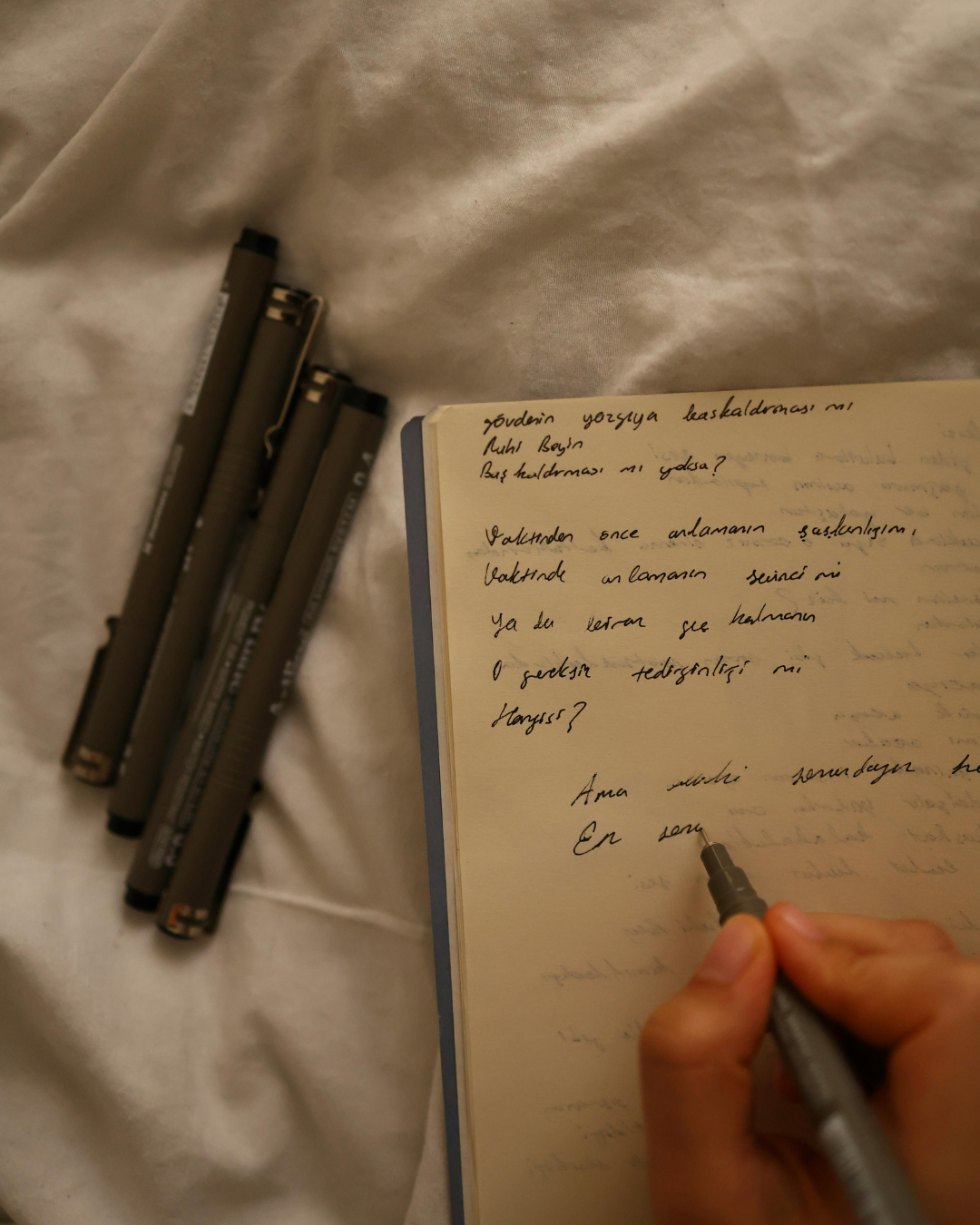
Most of my clients with anxious attachment already understand their pattern.
They can explain it beautifully. What they need is a way to catch it in the moment… and a journal is one of the simplest places to start.
I’ve been studying my own patterns since I was 18, and after more than 15,000 clinical hours as an attachment therapist, I can tell you that writing things down by hand can do one amazing thing: it can help you notice which state you’re in.
So these prompts are organized around the way I teach attachment in my free training: your state of being, the filter you see love through, and the strategies you use to get your needs met.

Before you start: why journaling helps anxious attachment:
When you’re anxious and overwhelmed, one of the main ways you manage it is by talking. You want to get it out, and usually you want to get it out to your partner.
That makes sense. It can become a pitfall, though, when talking to someone else is your only way to calm down.
A journal gives your feelings somewhere to go first. Then when you come back to your partner, you’re actually connecting with them… instead of trying to regulate through them.
A few simple rules:
- Write by hand if you can. It slows you down.
- Ten minutes is enough.
- Don’t edit. Nobody is grading this (including you).
- If you get flooded, stop, put your hand on your heart and breathe. You can come back to it.
Journaling prompts for your state of being:
At any given moment in a relationship, you’re either in a secure state or an insecure state (what I sometimes call a primal state). In an insecure state, no amount of insight changes what happens next, because the state is what’s driving you.
You can also see these two states as either being in your sympathetic nervous system (fight, flight, freeze or fawn), or your parasympathetic (the one where you can think creatively and powerfully).
So start here:
- Think about your whole day. Maybe it’s 13, 15 or 16 hours. How many of those hours were you in an insecure state, and how many in a secure state? Give yourself an actual number.
- Now think about your romantic or primary relationships. What percentage of that time are you reacting from threat or fear? (Could be 10%. Could be 50%. Could be 85%.)
- Where do I feel it in my body when I’m in an insecure state? What’s the first sign?
- What moved me into a calmer state today? A walk, a bath, a friend, nature?

Prompts for the six secure states:
In my Secure State Framework, a secure state is made of six states of being, the same ones children with secure attachment get to experience over and over: loved, supported, connected, mattering, alive, and at ease.
Pick one a day:
- Loved. When did I feel held by love today, instead of searching for it?
- Supported. Where am I carrying everything alone? What would it feel like to not have everything depend on me?
- Connected. Where do I belong? Who or what makes me feel part of something larger?
- Mattering. Where did I wait to be chosen today… and where could I choose?
- Playful. What made me free, playful or creative this week?
- Safe, at ease. What am I trying to force right now? What would it look like to let it unfold?
And then the question that ties them together:
- If I embody my secure state, aligned with my needs, what actions follow?
If you shift your state, behavior self-corrects.
Prompts for your filter:
Your history becomes the filter you see love through. When you’re anxiously attached, it can be really hard to tell what’s happening right now from what happened before.
- Is this me? Is this my partner? Or is this my history?
- What am I telling myself this means about me? What if this isn’t true?
- What would I do right now if it were easy?

Prompts for receiving:
So much of healing anxious attachment is learning to receive. A lot of times there IS more love available to you, and it’s hard to let it land.
- Where was love or support offered to me today that I didn’t fully take in?
- Someone said something kind to me. What happened in my body when I heard it?
- If I let myself be cared for this week, what would that look like?
Prompts for the moments you want to reach out:
These are for the 11 PM moments, before you send the text.
- What am I hoping this message will make me feel?
- Is this a venting session, or am I trying to connect?
- What do I need right now, and can I give some of it to myself first?
If you lean avoidant:
Journaling can help with avoidant attachment too, just from the other direction. Often the avoidant coping strategy is to not think about it. The growth is to spend time feeling your feelings, thinking them through, and figuring out what you want.
- What did I feel when my partner reached for me today?
- What did I do to feel okay again? (Work, exercise, a project?)
- If I stayed with this feeling for two more minutes, what would it tell me?
If you’re not sure which way you lean, I walk through it in anxious vs avoidant attachment.

How to keep going:
This takes repetition. As a kid you had the same experience thousands of times, so it’s really in your nervous system. As an adult it goes faster… and it still asks you to catch it, interrupt it, and choose a different state again and again.
So be gentle with yourself. The point is simply to notice.
Not sure which attachment style you lean toward?
Join the 22,000+ people who have already taken it.
If you want to go deeper into your state of being, your filter and your strategy, I teach all three in my free training, Attachment Essentials. It also gives you access to my free community.
With love,
Sefora